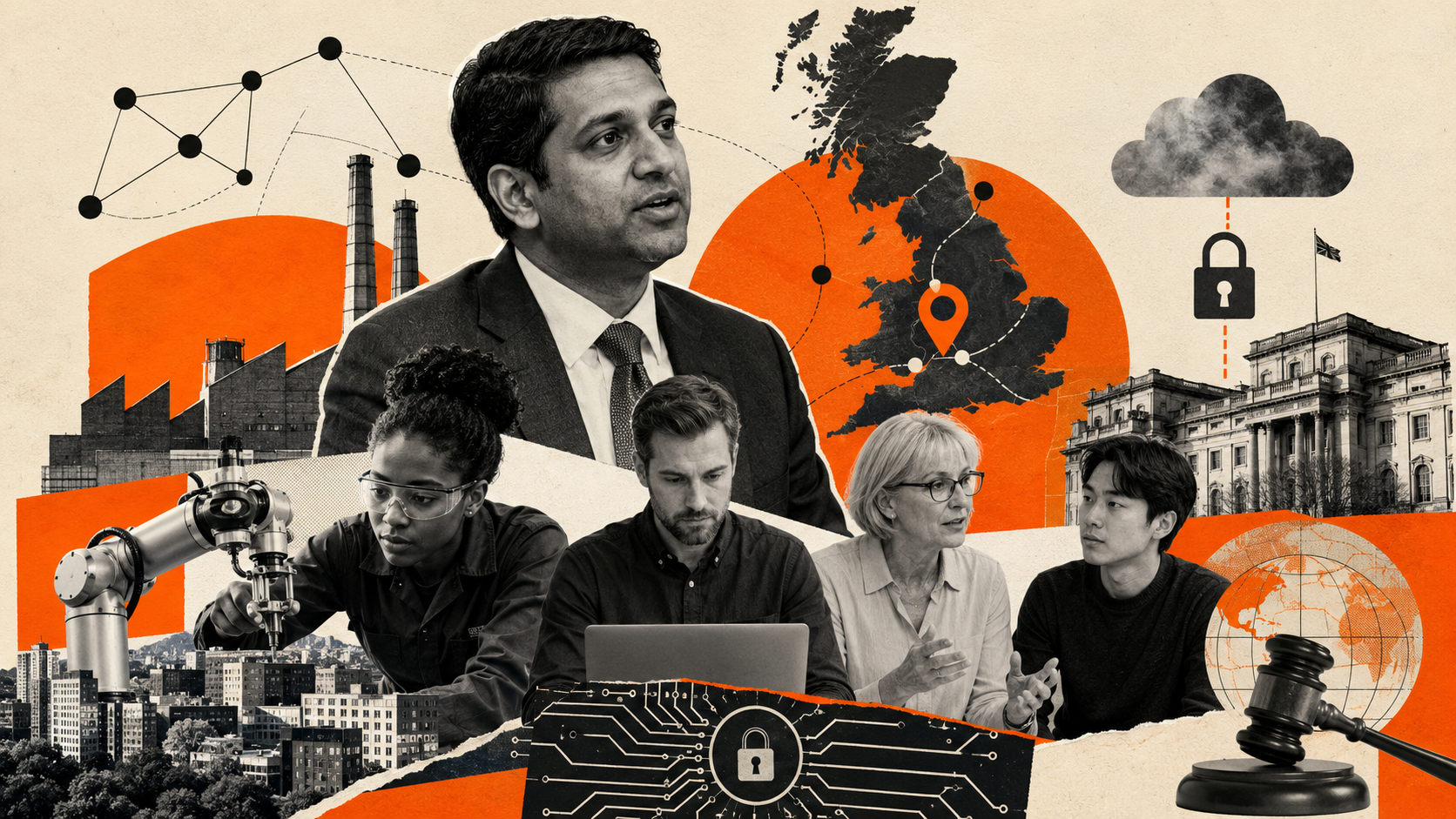
So, friend, you pulled the model down from Hugging Face last weekend. Seven gigabytes of weights, plus a GPU that finally earns its electricity bill (it’ll definitely cheapen your compute bill). It runs locally on your own hardware, & nothing leaves your network. That feels like ownership in the age of AI.
Then you go looking for the training data & the licence, & you notice what is not in the repo.
That gap is the argument. The Open Source Initiative made the point on its blog earlier this year: open weights & open source AI are different things, & the difference lands on the four software freedoms: to use, study, modify & share without asking the rights holder for permission. Weights give you the first one. Sometimes. The other three depend entirely on what came with them.
Run a weights-only model & what you have is a very large array of floating point numbers, plus a licence that may restrict commercial use or forbid certain applications & almost certainly does not include the training corpus or the data pipeline. You can fine-tune it. You cannot audit it and that will become an issue if/when AI regulations tighten. If someone asks you why your support bot refuses one category of customer query, you can shrug & say the base model does that. You cannot open the thing up, peak around inside & find out why, because the thing that would explain it, what went in, was never shipped with it.
When I run an AI literacy session that opens with five "is it OK?" scenarios, & the one that unsettles a room fastest is it ok for AI to be used in predicting crime hotspots from historical data. Nobody in the room defends it once they think about where the historical data came from, because all data is biased, historical policing data means the biases that come with this. In the States that often means be ex-black panther neighbourhoods. But the same logic applies to any model you did not see the training set for. You are inheriting decisions made by people you will never meet, & the licence you accepted does not give you the standing to question them.
I do not want to paper over any tension. Open weights are genuinely good. Llama & Mistral & Qwen put capable models on hardware people already own & broke the API-only chokehold. Plenty of useful independent work exists because of them. Also, calling them open source muddies a word that had a precise meaning & a set of enforceable rights attached to it. Both of those are true at once. The answer is to stop letting the marketing collapse two very different propositions into one.
The practical difference shows up at the point of failure. A weights-only model with a restrictive licence is fine until the licence changes, or your use case drifts into a prohibited category, or a client's procurement team asks for provenance you cannot produce. You have built on someone's terms of service with a longer expiry date. Components you can actually inspect survive that conversation: Apache licences & published data provenance.
I think the limiting belief here is that the choice is binary & that going properly open means giving up capability. It does not, & I would push back on anyone framing it that way. You can run open weights for the heavy lifting & keep every layer you control genuinely open & auditable: retrieval, prompts, evaluation harness, orchestration. Most of the risk in a production system lives in those layers anyway. The model is the part everyone talks about. Your data pipeline is the part that fails.
My prediction: within eighteen months, "what is the licence on the base model & can you evidence its provenance" becomes a standard line in UK public sector AI procurement questionnaires, the same way accessibility conformance did. The signal to watch is the first framework agreement that asks for it explicitly. If two years pass & procurement is still asking only about data residency, I was wrong & the market decided provenance is not worth the paperwork.
Ownership of a stack is an unglamorous discipline made of licence files & reproducible builds, & it is the difference between running software & renting it. Worth reading the licences of the tools you build your own stack from.
What is the actual difference between open weights & open source AI?
Open weights means you can download & run the model's parameters; open source AI means you also get the rights to study, modify & redistribute it without permission. The Open Source Initiative frames this against the four software freedoms. Weights deliver the freedom to use, often with licence restrictions, while the freedoms to study & share depend on whether training data & code were published.
Is Llama open source?
No. Llama is an open-weights model with a custom licence. You can download & run it locally, but the licence carries use restrictions & the training data is not published, so you cannot audit what shaped the model's behaviour or redistribute derivatives on open terms. None of that makes it less useful.
Does running a model locally mean I own my stack?
Running locally gives you data control. Ownership of the model is a separate question. Your inference stays on your hardware & nothing leaves your network. The licence still governs what you may do commercially, & without published training data you cannot explain the model's behaviour to a client, auditor or regulator.
Why does training data provenance matter if the model works?
Provenance matters because you cannot explain or defend model behaviour you cannot trace, & someone will eventually ask you to. A model trained on historical data inherits whatever patterns were in that data. Without the corpus, you are accepting decisions made by people you will never meet, with no standing to question them when a client challenges an output.
Can I use open-weights models & still keep control?
Yes, by keeping every layer you do control genuinely open & auditable. Run open weights for the model itself, then make sure retrieval, prompts, evaluation harness & orchestration use openly licensed components with reproducible builds. Most production risk sits in those layers rather than in the model, so that is where auditability pays off first.
.png?width=783&height=479&name=BBE%20Logo%20Teal%20Background%20(1).png "Bykov-Brett Logo")
 Jamie Bykov-Brett
·
19 September 2026
·
4 min read
Jamie Bykov-Brett
·
19 September 2026
·
4 min read